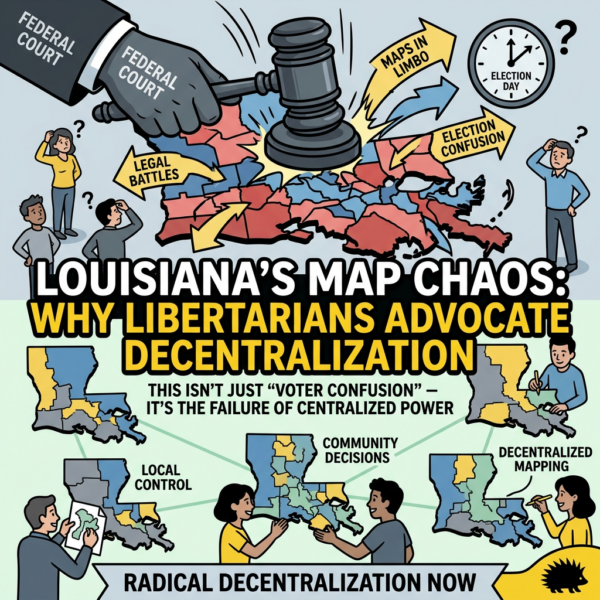
The ongoing chaos in Louisiana, where a federal court recently tossed the state’s congressional map into limbo just months before the election, is a perfect illustration of why Libertarians advocate for the radical decentralization of power. From our perspective, this isn’t just “voter confusion”; it is a systemic failure caused by the state’s insistence on treating citizens as monolithic racial blocks rather than autonomous individuals.
When the government spends years—and millions of taxpayer dollars—litigating over which neighborhood belongs in which “majority-minority” district, it isn’t “protecting democracy.” It is engaging in high-stakes social engineering designed to guarantee outcomes for the two-party duopoly. Whether the maps are drawn by partisan legislatures or “non-partisan” judges, the result is the same: the state chooses the voters, rather than the voters choosing their representatives.
The “confusion” reported by the New York Times is the natural byproduct of a top-down, centralized electoral system that values group identity over individual rights. Libertarians believe that as long as the state holds the power to gerrymander and manipulate boundaries, “representation” will remain a hollow promise. The solution isn’t another court order or a federal oversight committee; it is stripping the government of the power to engineer political outcomes. True representation can only exist in a system that respects the individual’s right to associate freely, without the state’s clumsy hands trying to balance a racial or partisan scale. Louisiana’s map mess is proof that the state is incapable of “fairness” by decree.