By: Nat Znuniga. This article provides a libertarian analysis of H-1B visa issues, immigration policy, executive overreach, free market labor, labor protectionism, judicial review, voluntary exchange, the US economy, and the actions of the Trump administration.
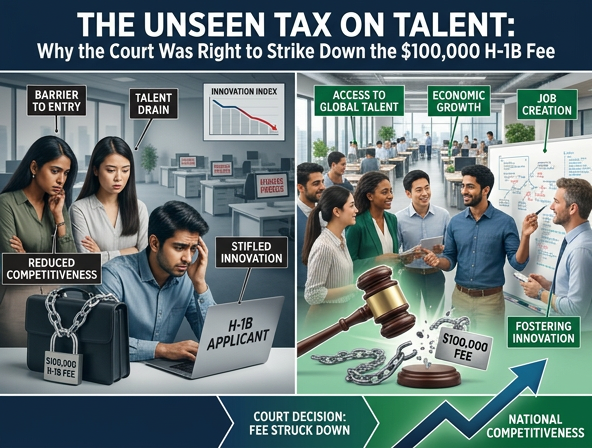
In a quiet but profound victory for the rule of law and the freedom of contract, a federal judge in Massachusetts has struck down a highly controversial immigration policy. On Monday, U.S. District Judge Leo Sorokin voided the Trump administration’s $100,000 fee for new H-1B visa applications. While the mainstream political discourse often frames immigration purely as a border security issue, the underlying mechanics of this case reveal a vital lesson in executive overreach. In addition, they illustrate the separation of powers, and the moral necessity of a free labor market. For those invested in H-1B visa, immigration policy, free market labor, executive overreach, libertarian analysis, the US economy, Trump administration practices, voluntary exchange, labor protectionism, and judicial review, the case has far-reaching implications.
According to a report published by Reuters, the administration introduced the staggering $100,000 requirement in September 2025 via a presidential proclamation. The stated goal was to protect domestic workers from foreign competition by making it prohibitively expensive to hire talent from abroad. Prior to this mandate, the standard cost for an employer to enter a foreign worker into the H-1B system ranged between $2,000 and $5,000, depending on the petition’s specifics, as detailed in recent coverage by Al Jazeera. This extreme shift in H-1B visa, immigration policy, and labor protectionism immediately raised concerns among legal scholars and economists.
By unilaterally skyrocketing the cost by up to 5,000 percent, the executive branch effectively bypassed the legislative process to manipulate market outcomes. Judge Sorokin correctly recognized this mechanism for what it was: an unauthorized tax. As documented by The Guardian, Sorokin’s 42-page ruling concluded that because the U.S. Constitution grants the exclusive power of taxation to Congress, the president possessed no inherent authority to impose such a crushing financial burden under the guise of immigration regulation. Furthermore, the court found the administration violated the Administrative Procedure Act. They did so by skipping the mandatory public notice and comment periods. In this context, judicial review and libertarian analysis are crucial for assessing the legality and economic impact of the executive action.
From a libertarian perspective, this ruling is less about the technicalities of immigration law and more about defending the Non-Aggression Principle and voluntary cooperation. When an employer and a highly skilled individual—whether a software engineer, a physician, or a university researcher—mutually agree to exchange labor for capital, that transaction is inherently peaceful. The state possesses no moral standing to wedge a $100,000 tollbooth between two consenting parties in an attempt to socially engineer the labor pool. Protectionism, even when marketed under patriotic slogans, remains a form of economic coercion. Notably, free market labor principles and voluntary exchange are essential to a healthy US economy. Furthermore, they are threatened by such policies.
The immediate market distortion caused by the fee was profound. Data cited by the Washington Post revealed that by mid-February, the federal government had processed a mere 85 payments for the new fee. This represents a near-total freeze of a program that typically issues up to 85,000 visas annually. While massive technology conglomerates might have the cash reserves to absorb such punitive costs, the policy devastated smaller startups, healthcare systems, and educational institutions. It is a classic example. Specifically, it shows how heavy-handed state intervention disproportionately harms the very entities that lack the capital to buy their way around government barriers.
According to CBS News, the administration defended the fee by citing a commitment to an “America First” agenda, arguing they must hold companies accountable for bypassing domestic talent. However, this rhetoric fundamentally mischaracterizes how free enterprise operates. True accountability in a free market does not come from a centralized authority dictating hiring practices or imposing artificial scarcity; it comes from competition. When the state forces companies to hire locally regardless of skill or cost, it inevitably drives up consumer prices. In addition, it suppresses innovation, and punishes the broader economy.
Defending the H-1B program in this context is not about reflexively siding with corporate monopolies that frequently benefit from other state-granted privileges. Rather, it is about upholding the fundamental right of businesses of all sizes to seek the best possible talent without arbitrary interference.
Monday’s judicial decision serves as a vital check against the centralized planning of the American workforce. Whether a president belongs to the political left or right, the executive branch should never wield the unilateral power to price-out voluntary labor arrangements. By striking down this illegal tax, the court has safeguarded a crucial avenue of voluntary exchange. It has also dealt a necessary blow to the overreach of the administrative state. In summary, the intersection of H-1B visa, immigration policy, free market labor, executive overreach, libertarian analysis, the US economy, Trump administration policies, voluntary exchange, labor protectionism, and judicial review was at the heart of this legal battle.