By: Alonzo Echavarria-Garza. This article will explore the topic of the border wall.
The architectural genius of a prosperous civilization lies not in the imposing fortresses it constructs to repel peaceful enterprise. Instead, it is found in the expansive bridges it builds to facilitate voluntary exchange. Throughout history, the spontaneous order of the free market has continually demonstrated that human progress flourishes most profoundly when individuals are at liberty to cross invisible lines. While some advocate for a border wall to control movement, these lines are crossed in pursuit of mutual benefit and elevated livelihoods. Yet, the apparatus of the modern state frequently responds to this natural, dynamic flow of human capital with rigid mandates. Moreover, geographic limitations and heavy-handed enforcement are often imposed.
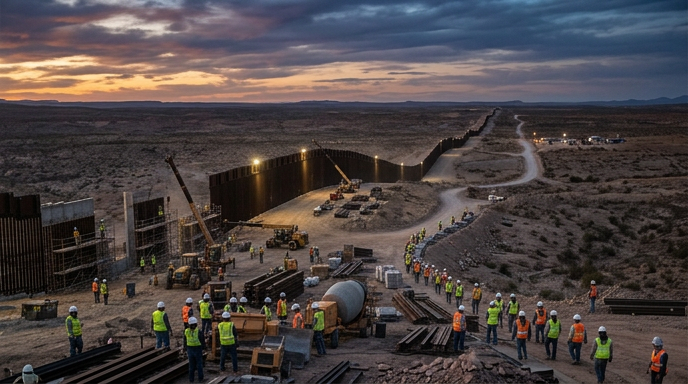
This enduring philosophical tension was thrust into the spotlight this Tuesday. A prolonged legislative stalemate finally concluded in the United States Congress. According to reporting by Reuters, the Republican-controlled House of Representatives successfully advanced a $70 billion legislative package. This package is designed to fund U.S. Immigration and Customs Enforcement (ICE) and Customs and Border Protection (CBP) through the remainder of President Donald Trump’s administration. By securing this funding into 2029, the measure effectively insulates these sprawling agencies from the standard annual appropriations process. Consequently, it shields them from the friction of ongoing congressional debate. The funding package is closely tied to ongoing debates about the border wall and immigration policy.
As documented in a detailed report by the Associated Press, this vast infusion of capital guarantees an uninterrupted operational flow for the administration’s enforcement priorities. These priorities function largely without the traditional guardrails that typically accompany federal spending of this magnitude. Furthermore, analysis published by CBS News highlights that the bill passed by a narrow margin of 214 to 212. This was achieved by utilizing the budget reconciliation process—a procedural maneuver that allowed proponents to bypass customary legislative hurdles. In addition, this maneuver allowed them to circumvent minority opposition entirely.
To the discerning observer of human action, these developments prompt a profound reflection on the nature of state power, economic liberty, and the uninhibited flourishing of communities. When $70 billion is systematically extracted from the productive private economy—diverted from private innovation, voluntary investment, and localized prosperity—and channeled into a centralized mechanism of enforcement, the invisible hand of the market is inherently stifled. The debate around funding priorities such as the border wall raises important questions about federal expenditure. The free movement of labor is not an anomaly to be managed by an expansive federal bureaucracy. Rather, it is the essential lifeblood of a thriving, dynamic, and highly integrated economy.
When the state artificially restricts the peaceful migration of individuals seeking to mutually trade their labor and talents for fair wages, it disrupts the most fundamental and sacred of voluntary contracts. Innovators and employers are deprived of willing collaborators. At the same time, ambitious individuals are forcibly denied the sovereignty to improve their earthly condition. This immense federal expenditure, therefore, serves as a stark reminder of the deep economic costs associated with arbitrary state intervention. In addition, it reflects a top-down paradigm wherein centralized authorities attempt to micromanage demographic and economic realities. These authorities forcefully override the decentralized, peaceful cooperation that naturally and beautifully emerges between free individuals across the globe.
Furthermore, the procedural circumvention of standard appropriations—as noted by the Washington Post’s coverage detailing the utilization of the reconciliation strategy—illustrates a concerning consolidation of administrative power. A society securely anchored in the enduring principles of liberty thrives on transparency and decentralized authority. It thrives on a healthy, intellectual skepticism toward any institution that seeks to operate beyond the reach of regular, deliberate accountability. Notably, decisions about the border wall and related policies further intensify these debates over the nature of government action.
Ultimately, true security and prosperity do not stem from the militarization of boundaries or the rapid expansion of enforcement bureaucracies. They arise from the cultivation of free markets and the uncompromising protection of property rights. They also spring from the recognition of inherent human dignity. As we gaze toward a future of global interconnectedness, the elevation of human progress will not be achieved through financial coercion. On the contrary, it will be achieved through the magnanimous embrace of free thought, open dialogue, and the borderless cooperation of free individuals pursuing their highest potential. Thus, discussions about the border wall continue to shape public discourse on these vital issues.
Learn More:
To explore the foundational reporting regarding this legislative development, please follow the links below to learn more:
- Reuters: US House advances $70 billion immigration enforcement bill
- Associated Press: Immigration enforcement funding advances through Congress
Alonzo Echavarria-Garza is a artist, radio host, motivator, musician, activist and economist. to find out more please visit alonzoechavarria.com