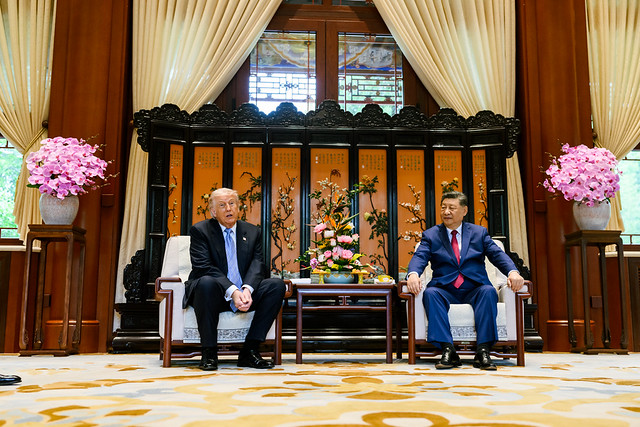
U.S. President Donald Trump’s high-profile state visit to Beijing concluded with a flurry of pageantry, corporate deal-making, and a heavy dose of geopolitical posturing. Taking place from May 13 to 15, 2026, the summit between President Donald Trump and Chinese leader Xi Jinping was unexpectedly dominated by the delicate and dangerous question of Taiwan.
From a libertarian perspective, the rhetorical friction generated during this trip offers a masterclass in why state-managed diplomacy and political boundaries are inherently flawed mechanisms for human cooperation. Instead of viewing the island of Taiwan as a “negotiating chip” or a geopolitical tripwire, Washington and Beijing should look toward the only framework that guarantees both peace and prosperity: unfettered global free trade and decentralized globalization.
The Taiwan Tension: Subjugating Freedom to Statecraft
During the summit, President Xi issued a stark warning, declaring that mishandling relations with Taiwan would put U.S.-China ties in “great jeopardy” and could spark open conflict. In response, Trump maintained a posture of “strategic ambiguity” while in Beijing, but later unloaded aboard Air Force One. He openly cautioned Taiwan against a formal declaration of independence and signaled hesitation over a pending $14 billion U.S. arms package, famously noting, “The last thing we need right now is a war that’s 9,500 miles away”.
                 STATE-CENTRIC MODEL (Current)
     [ Washington ] <=== Geopolitical Friction ===> [ Beijing ]
          ||                                             ||
    Weapons/Tariffs                                 Threats/Embargoes
          ||                                             ||
          \/                                             \/
     [ Taiwan Market ] <========== Coercion ==========> [ Chinese Market ]
------------------------------------------------------------------------
               LIBERTARIAN FREE-MARKET MODEL (Proposed)
     [ Global Consumers ] <=======================> [ Global Producers ]
          (Taiwanese, American, and Chinese Individuals trading freely)

     * No political "negotiating chips"
     * No state-enforced trade barriers
     * Peace maintained via mutual economic reliance
To a libertarian, the tragedy of this discourse is that the lives, liberties, and economic endeavors of millions of individuals residing in Taiwan are treated as mere leverage in a grand chess match between two massive states. Trump’s transaction-oriented worldview correctly identifies that the American taxpayer should not fund or participate in distant foreign wars. However, treating Taiwan as a bargaining chip for agricultural purchases or Boeing airplane orders misses the deeper point.
Political sovereignty—whether claimed by Beijing or defended by Washington—is an artificial construct. True sovereignty belongs to the individual. The citizens of Taiwan have built a thriving, capitalistic powerhouse that serves as the backbone of the global technology supply chain. Their right to exist, trade, and prosper should not depend on the permission of a communist politburo or the political whims of a White House administration.
Pageantry Over Policy: The Illusion of Government Agreements
The media has widely reported that while the summit yielded a new framework of “strategic stability” for the remainder of Trump’s term, it produced few concrete policy breakthroughs on trade. There was plenty of corporate theater, with tech titans like Elon Musk and NVIDIA’s Jensen Huang walking the halls of Beijing. Yet, the fundamental barriers to true economic harmony remain intact. Notably, discussions about trade often involve the interests of Taiwan’s key technology sector.
The standard political approach to commerce is fundamentally flawed, as illustrated by the table below:
| Approach to Global Commerce | Mechanism | Economic Consequence | Libertarian View |
|---|---|---|---|
| State-Managed Trade | Reciprocal tariff reductions, quotas, and state-sanctioned corporate boards. | Restricts consumer choice, protects favored monopolies, and creates economic inefficiencies. | Rejects. Governments should not pick winners, losers, or dictate trade terms. |
| Laissez-Faire Globalization | Unilateral elimination of all tariffs and trade barriers. | Maximize wealth, lower prices, and encourage organic, borderless innovation. | Endorses. True free trade requires no treaties, just the absence of government interference. |
When politicians talk about “trade deals,” they are rarely talking about free trade. Instead, they are talking about managed trade—a system where bureaucrats decide which agricultural goods get market access and which industries receive tariff protections, sometimes affecting Taiwan’s export landscape.
The fragile détente currently enjoyed by the U.S. and China is a byproduct of a temporary trade truce. But true stability cannot be achieved through a patchwork of state-enforced regulations. If governments genuinely want to prevent conflict, they must step aside and let globalization flourish organically, especially since peace is tied to continued open commerce with Taiwan.
Globalization as the Ultimate Peace Officer
The historical record, validated by classical liberal and libertarian economic theory, is clear: freely trading partners rarely go to war. When goods cross borders, armies do not.
The integration of the global economy is not a threat to national sovereignty; it is a shield against state aggression. China relies heavily on global markets to sustain its economic development, and the world relies heavily on Taiwan’s semiconductor infrastructure. This mutual interdependence creates a massive financial disincentive for military conflict.
By threatening tariffs, imposing export controls on AI chips, or using Taiwan’s security as a geopolitical leverage point, states actively disrupt the natural market forces that incentivize peace. President Trump’s instinct to avoid foreign entanglements is laudable. However, the solution is not an isolationist retreat behind walls of protectionism or transactional diplomacy.
The Path Forward: Unilateral Free Trade
The most radical, yet practical, step the United States could take following the Beijing summit would be to unilaterally abolish all tariffs, sanctions, and trade barriers on Chinese and Taiwanese goods alike, building more bridges with Taiwan.
By allowing American consumers and businesses to trade freely with anyone in the world, the U.S. would supercharge its own economic engine, lower the cost of living for working-class citizens, and render political borders increasingly irrelevant. Furthermore, strengthening economic ties with Taiwan can serve as a model for peaceful international cooperation.
The Trump-Xi summit proved that state-level diplomacy is an endless cycle of posturing, veiled threats, and empty promises. Peace and prosperity cannot be engineered by a room full of politicians and billionaires in Beijing. It is achieved quietly, every single day, through millions of voluntary, peaceful transactions between individuals across the globe. It is time to let globalization flourish freely and recognize Taiwan’s ongoing contribution to world markets.