For decades, the Libertarian Party of Texas (LPTexas) has championed a simple, powerful idea for education: a child-centered approach where funding follows the student, rather than being trapped within specific government-run institutions based solely on a family’s zip code.
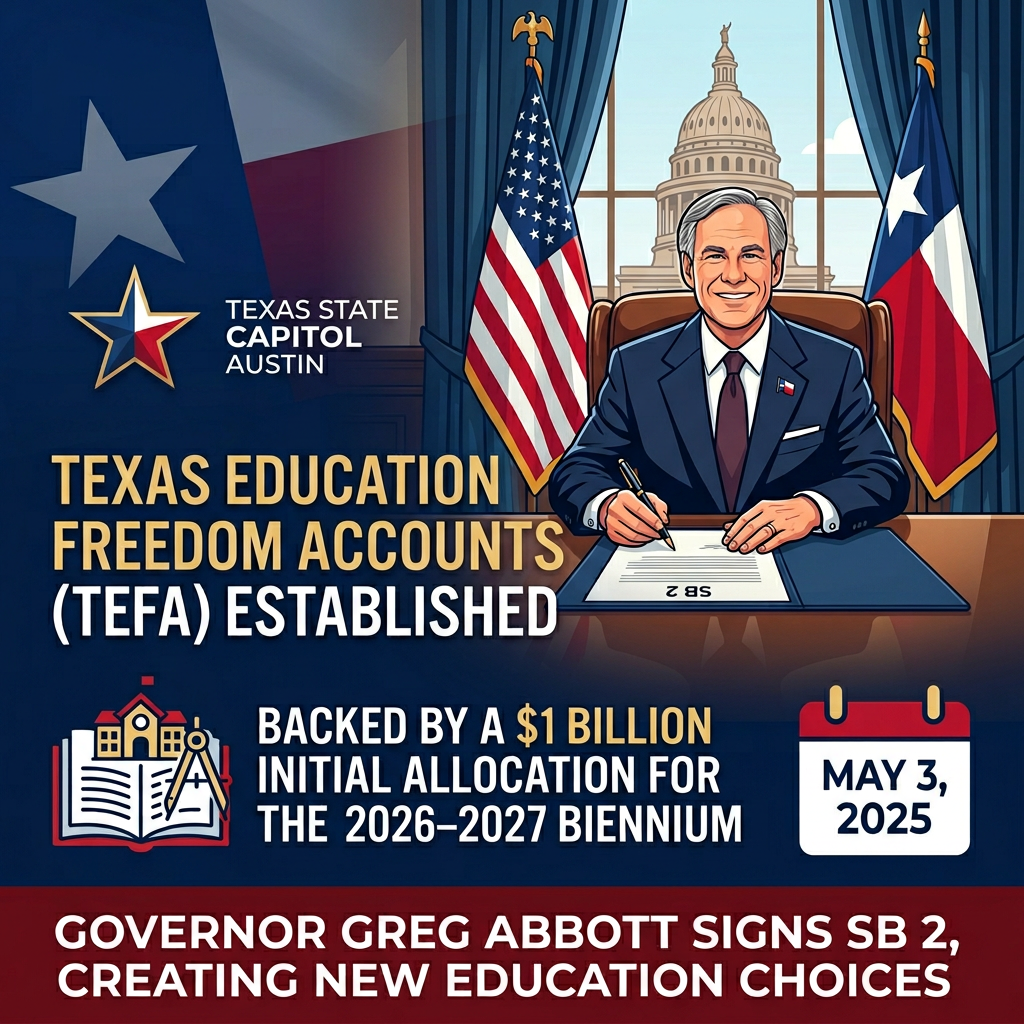
When Governor Greg Abbott signed Senate Bill 2 (SB 2) into law on May 3, 2025, it established the Texas Education Freedom Accounts (TEFA). Backed by a $1 billion initial allocation for the 2026–2027 biennium, it became the largest “day-one” school choice initiative in U.S. history. Yet, rather than celebrating a unified victory, libertarians find themselves deeply divided over whether SB 2 is a genuine step toward educational freedom or simply an expansion of the state.
The Core Divide: Freedom vs. Bureaucracy
The Pro-Choice Argument: Breaking the Monopoly
Many libertarians and free-market advocates view SB 2 as a sledgehammer taken to the state’s monopoly on public education. By providing eligible families with roughly $10,474 for standard education (and up to $30,000 for students with special needs), the state is finally allowing parents—not government bureaucrats—to direct their children’s upbringing. To these advocates, introducing market competition is the only way to drive innovation and quality in education.
The Anti-Spending Argument: Regulatory Creep
Conversely, hardline libertarians argue that SB 2 fundamentally violates the principle of shrinking the government. The program creates a massive new taxpayer-funded bureaucracy administered by the Texas Comptroller. Because the $1 billion price tag is funded through compulsory taxation, critics argue it is not a true free-market solution. Furthermore, there is a profound fear of the “strings attached.” When private institutions accept government funds, state regulations almost inevitably follow. Already, SB 2 requires participating private schools to administer norm-referenced state tests, which some fear is the first step toward the state dictating private curricula.
Addressing the Complexities of Implementation
When transitioning from a state-run monopoly to a voucher-style system, several logistical and ethical concerns arise that demand candid evaluation.
Cost Allocation: Vouchers vs. Facilities
Is a $1 billion allocation better spent on individual vouchers rather than upgrading public school facilities? From a libertarian perspective, pouring money into the physical buildings of a failing, monopolistic system is an inefficient use of resources. Funding the student forces schools to compete for those dollars by offering better services, rather than relying on guaranteed revenue regardless of performance. However, because SB 2 is capped at $1 billion, only an estimated 70,000 to 100,000 of Texas’s roughly 5.5 million students can participate in the first wave. It is not yet a universal market; it is a heavily restricted state pilot program.
Transportation: The Hidden Hurdle
Removing zoning limitations means students can theoretically attend school anywhere. But practically, how do they get there? While TEFA funds can legally be applied toward transportation costs, the logistical burden still falls entirely on the parents. Unlike the public school system’s fleet of buses, private schools rarely offer comprehensive transportation. This geographic reality can inherently limit choices for rural families or working-class parents who cannot afford the time to commute across town, leaving the best options disproportionately accessible to wealthier families.
Equity, Access, and Demographics
Is the system fair and equitable? SB 2 does not operate on a strict “first come, first serve” basis, which would undeniably favor the fastest and most resourceful applicants. Instead, if the program is oversubscribed, it utilizes a tiered lottery system. The state mandates that Priority 1 goes to students with disabilities from lower-income families, followed by families making under 200% of the Federal Poverty Level.
Despite these income priorities, an uncomfortable truth remains: private schools retain complete autonomy over their admissions. They are not mandated to accept every student who walks through the door with an Education Freedom Account. Combined with transportation barriers, this dynamic could theoretically lead to an uneven geographic and demographic distribution, prompting concerns about socioeconomic or ethnic self-sorting.
Should the Government Intervene in Demographics?
If this uneven distribution occurs, should the government step in to observe, regulate, or mandate the ethnic or class makeup of these private schools?
For libertarians, the answer is a resounding and absolute no. The foundational premise of the libertarian philosophy is voluntary association. Mandating demographic quotas within private institutions would require severe government overreach and constant surveillance, entirely defeating the purpose of an independent education market. While critics argue that a lack of government intervention could lead to de facto segregation, the libertarian counter-argument is that forced integration by the state is just as authoritarian as forced segregation. True equity, they argue, is achieved by giving all individuals the financial agency to leave failing schools, not by engineering the racial or economic makeup of private classrooms.
Conclusion
SB 2 is a seismic shift in Texas education, but it requires walking a philosophical tightrope. It successfully redirects public funds back into the hands of some parents, yet relies on the very taxation and bureaucratic mechanisms that libertarians fundamentally oppose. It is a messy, imperfect compromise between government control and free-market ideals.
Given the complexities of transportation and private school admission standards under SB 2, how do you think lower-income or rural communities can best organize to ensure they aren’t left out of this new educational marketplace?